
Most companies do not argue about SEO vs PPC because they enjoy marketing theory. They argue about it because budget is limited.
One team wants faster leads. Another team wants lower dependency on ads. Someone is looking at rising CPCs in Google Ads. Someone else is asking why the website still does not get enough organic traffic after months of content work.
Both sides usually have a point.
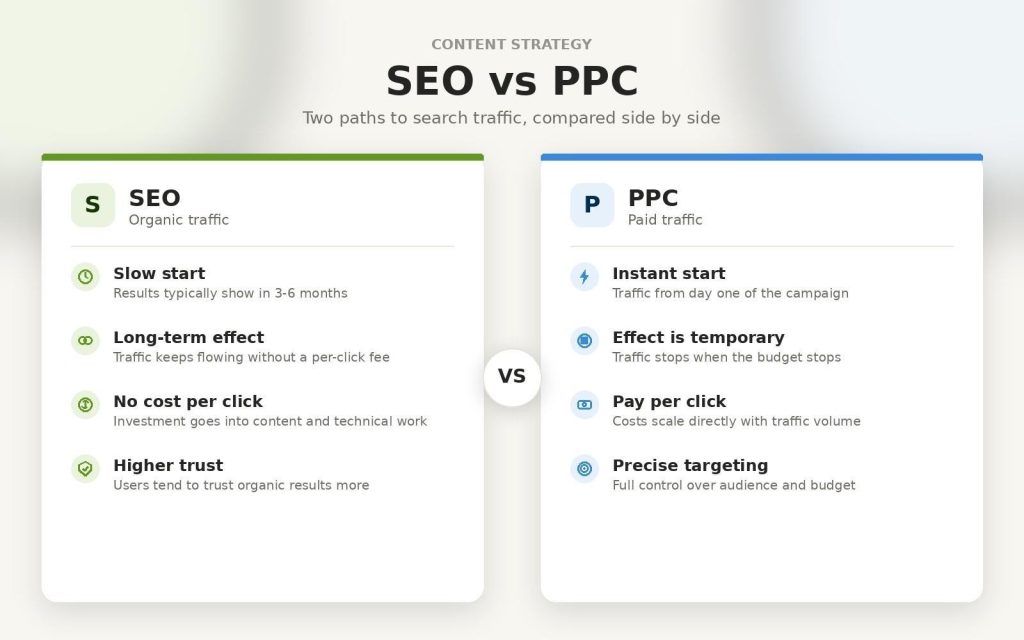
PPC ads can put your business in front of potential customers quickly. That matters when you are launching, testing a new offer, or trying to hit this quarter’s pipeline number. Search engine optimization works differently. It takes longer, but it can build traffic that does not disappear the moment you stop paying for clicks.
This article is for business owners, marketing managers, and teams deciding where to place their next investment: paid advertising, organic SEO, or a mix of both.
The practical answer: use PPC when speed and testing matter most; use SEO when you want long-term growth; use both when you have enough tracking, budget, and discipline to make the data work across channels.
Quick Answer: SEO or PPC First?
Start with PPC if you need traffic quickly.
A Google Ads campaign can be launched much faster than an SEO campaign can rank. If the offer is clear, the landing page is ready, and conversion tracking works, paid search can start bringing visitors almost immediately. This is useful for launches, seasonal campaigns, emergency lead generation, local service demand, or testing a new market.
Start with SEO if you already know people are searching for your product or service and you are not under pressure to get leads tomorrow.
SEO requires more patience. Search engines need time to crawl your pages, understand changes, compare your content with competitors, and adjust rankings. For many websites, stronger SEO results take several months. In competitive markets, it can take longer.
Use SEO and PPC together if you want short-term visibility and long-term growth. PPC can show which search queries convert. SEO can turn those search queries into pages that bring traffic without paying for every click.
The one thing you should not do: scale either channel before tracking is fixed. If conversions are not measured properly in Google Analytics, Google Ads, CRM, or call tracking, you are guessing.
SEO vs PPC: The Simple Difference
What SEO does
Search engine optimization improves your website’s visibility in organic search results.
That means your pages appear in search results because search engines consider them relevant and useful, not because you paid for each visit. SEO includes technical fixes, content work, keyword research, on page optimization, internal links, off page SEO, link building, and ongoing measurement.
SEO is not just blog writing. A strong SEO strategy usually touches service pages, category pages, product pages, technical SEO, content quality, page speed, internal linking, and conversion paths.
The benefit is durability. A page that ranks well can keep bringing seo traffic for months or years. You may still need to update it, protect rankings, and improve the page, but you are not charged every time someone clicks.
The hard part is timing. SEO requires patience and implementation. If your website is new, technically weak, or competing against established brands, organic rankings will not move overnight.
What PPC does
PPC means pay per click. You pay when someone clicks your ad.
In search advertising, that usually means running campaigns through Google Ads or other PPC platforms. Your ads can appear in paid search results when users search for the keywords you target.
PPC gives immediate visibility. That is its biggest advantage. If someone searches for “Google Ads agency pricing” or “technical SEO audit service,” a paid ad can place your offer near the top of the search results page without waiting for organic rankings.
The weakness is cost. PPC involves paying for every click or conversion. If you stop paying, the ads stop. Traffic from PPC halts when the budget ends.
That does not make PPC bad. It just means it needs strong control. A good PPC campaign can bring qualified traffic. A bad one can burn through ad spend without creating revenue.
The real difference
SEO builds organic visibility. PPC buys paid visibility.
SEO is more like building an asset. PPC is more like renting attention.
That difference matters when you build a digital marketing strategy. PPC is useful when you need fast data, fast visibility, and fast testing. SEO is better when you want to build a channel that gets stronger over time.
The smartest answer is rarely “only SEO” or “only PPC.” The better question is: which channel should do which job?
How Google Ads and PPC Ads Work
Google Ads works through an auction. When someone types a search query, Google checks which advertisers are eligible to show ads for that query.
Your bid matters, but it is not the whole story. Google also looks at ad relevance, expected click-through rate, landing page experience, and ad quality. This is why the highest bid does not always win.
A company with a relevant ad, a strong landing page, and a clear offer can sometimes compete more efficiently than a company that simply bids higher.
PPC ads can appear in different places depending on campaign type:
- above organic results;
- below organic results;
- in Shopping results;
- on Google Maps;
- on YouTube;
- across display placements;
- through remarketing.
For many businesses, paid search is the first PPC channel to test because it captures people who are already looking for a solution. Users search, the ad appears, and the landing page has a chance to convert them.
Common paid ads formats include search text ads, shopping ads, display ads, video ads, local ads, remarketing ads, and Performance Max placements.
For service businesses, B2B, SaaS, and ecommerce, search ads are usually the cleanest starting point because the intent is easier to read.
Keyword Bidding and PPC Mechanics
Keyword bidding decides how aggressively you compete for a search query.
You select keywords, write ads, choose a landing page, set targeting, and tell Google how you want to bid. That may be manual bidding, automated bidding, target CPA, target ROAS, or a conversion-focused strategy.
But PPC is not just a bidding game.
A high bid with poor relevance can waste money. A better ad with a better landing page can often perform more efficiently. This is why landing page optimization matters so much in PPC marketing.
For a new account, I would not rush into full automation. Manual CPC can help when you need control. Maximize Conversions can work once tracking is reliable. Target CPA or Target ROAS should usually wait until the account has enough conversion data.
Automated bidding can be useful, but it is only as good as the data behind it. If the account is tracking weak leads, accidental clicks, or low-value form fills as conversions, automation will optimize toward the wrong thing.
Keyword Research for PPC and SEO
Keyword research should serve both channels.
Too often, PPC has one keyword file and SEO has another. That creates wasted work. Both teams need to understand search intent, competition, CPC, conversion potential, and which pages should target which terms.
Start with high-intent terms. These are the searches that suggest someone is close to action:
- “technical SEO audit service”
- “PPC management agency”
- “Google Ads consultant”
- “SEO consultant for B2B”
- “local SEO services near me”
Then separate keywords by funnel stage.
Informational keywords are better for SEO content. These are the queries people use when they are researching:
- “difference between SEO and PPC”
- “which is better SEO or paid search”
- “how does PPC advertising work”
- “what is technical SEO”
Commercial and transactional keywords can work for both SEO and PPC. These are closer to decision-making:
- “SEO services for small business”
- “Google Ads agency pricing”
- “PPC advertising services”
- “SEO vs paid search agency”
For PPC, check CPC estimates before choosing paid-priority terms. Some keywords look perfect until the cost makes the campaign unrealistic.
For SEO, check keyword difficulty, existing competitors, content quality, backlink strength, and whether your own site has enough authority to compete.
Good keyword research should not stop at search volume. It should answer this: which relevant keywords can bring qualified traffic that may actually become revenue?
Keyword Bidding
Initial bids should come from numbers, not instinct.
Look at CPC benchmarks, expected conversion rate, average deal size, close rate, and customer lifetime value. A $20 click can be cheap if it brings a $20,000 customer. A $2 click can be expensive if it brings poor leads.
A simple example:
If a keyword costs $10 per click and the landing page converts at 5%, you need about 20 clicks for one lead. That puts the rough cost per lead at $200 before management cost.
That number might be excellent for a B2B service. It might be too high for a low-margin ecommerce product.
In the first few weeks, review search terms often. Keywords are what you target. Search terms are what people actually typed before clicking.
That distinction matters.
Move budget toward queries with strong intent and good lead quality. Cut spend where the campaign produces clicks but no pipeline.
SEO Components: On-Page, Off Page SEO, and Technical
SEO has three main parts: on-page, off-page, and technical.
On-page SEO is everything you improve on the page itself. For landing pages, that includes title tags, meta descriptions, headings, copy, internal links, CTAs, structured data, content quality, and search intent alignment.
Off page SEO is about authority outside your website. This includes link building, brand mentions, digital PR, citations, partnerships, and high quality backlinks from reputable sites.
Technical SEO makes sure search engines can crawl, index, and understand the website. Weekly checks should include broken links, redirects, canonical tags, sitemap issues, robots.txt rules, index coverage, duplicate pages, site speed, mobile usability, and server errors.
This also affects PPC. A slow website, broken form, or poor mobile experience will waste paid traffic. PPC can bring the visitor, but the website still has to convert.
Head-to-Head Metrics and KPIs
Do not compare SEO and PPC by traffic alone.
Traffic is easy to report and easy to misunderstand.
For PPC, watch cost per click, cost per lead, conversion rate, ROAS, CAC, impression share, search term quality, and landing page conversion rate.
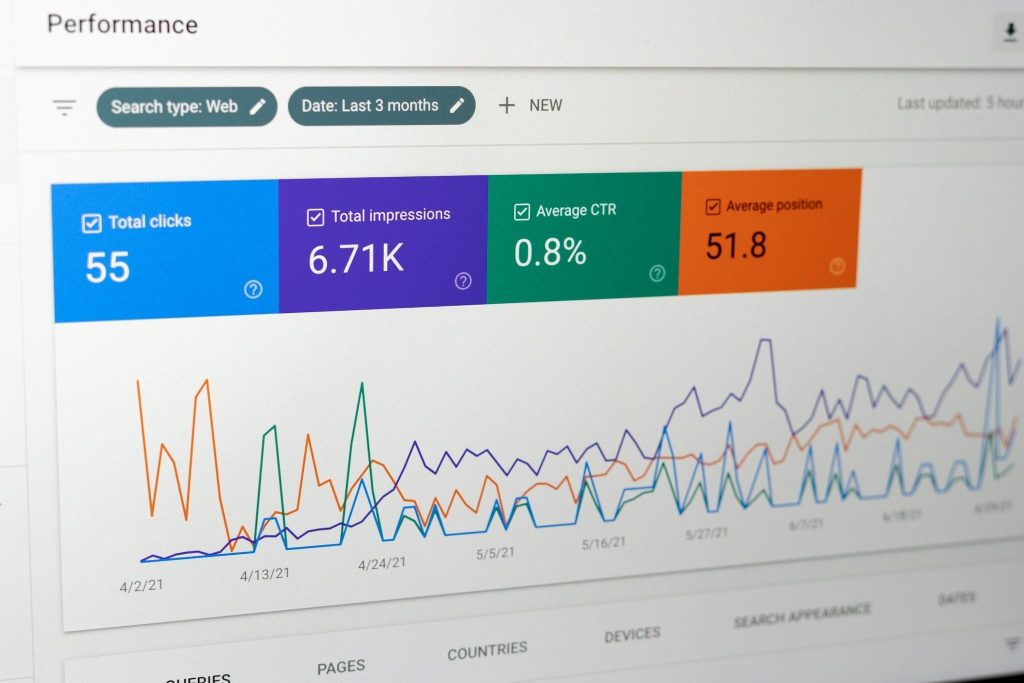
For SEO, watch organic traffic, non-brand clicks, impressions, organic search rankings, CTR from organic search results, conversions from organic search, assisted conversions, and revenue or pipeline from SEO traffic.
The fair comparison includes customer lifetime value.
PPC may bring leads faster. SEO may bring leads at a lower long-term cost. But the best channel is not always the cheapest one. It is the channel that brings customers the business actually wants.
Also, SEO is not free. It does not charge per click, but it still costs money. Strategy, technical SEO, content, development, link building, SEO tools, and reporting all require budget.
PPC cost is obvious because it appears as ad spend. SEO cost is less obvious because it is spread across work, people, and implementation.
Pros and Cons: Paid Ads Versus Organic Traffic
Paid ads are strongest when speed matters.
They can support product launches, seasonal campaigns, short-term offers, and urgent lead generation. They also allow tighter targeting by location, device, audience, demographics, and behavior.
PPC also gives useful data quickly. You can test search queries, ad copywriting, CTAs, landing pages, and offers before spending months building SEO pages around the wrong assumptions.
The drawback is cost. PPC costs can add up quickly because every click has a price. A successful PPC campaign can still become expensive as a long-term strategy if CPC rises or conversion rates drop.
Organic traffic works differently.
SEO builds visibility over time. Strong organic results can support brand trust, more organic traffic, lower dependency on paid advertising, and long-term growth.
The drawback is that SEO requires ongoing work. Search engine algorithms change. Competitors improve. Content gets old. Technical issues appear. Rankings need maintenance.
SEO is often less expensive long term, but only when the work is done properly. Weak SEO can waste budget just as easily as weak PPC.
SEO vs PPC Comparison Table
| Factor | SEO | PPC |
| Main role | Build organic visibility | Buy immediate visibility |
| Placement | Organic results | Paid search results |
| Cost model | Strategy, content, technical work, links | Pay per click or conversion |
| Speed | Slower | Faster |
| Traffic duration | Can continue after rankings improve | Stops when spend stops |
| Best use | Long-term growth | Launches, tests, urgent demand |
| Main risk | Slow execution, algorithm changes | High CPC, wasted ad spend |
| Data source | Google Search Console, GA4, SEO tools | Google Ads, GA4, CRM |
| Best KPI | Qualified organic traffic and conversions | CAC, CPL, ROAS, conversion rate |
| Dependency | Website quality, content, authority | Budget, bids, ad quality, landing pages |
Both SEO and PPC can drive traffic. The better question is which one can drive qualified traffic at a cost the business can sustain.
Targeting Potential Customers: Audience and Funnel Use
PPC works well for high-intent queries.
These are searches where the user is close to taking action:
- “book SEO consultation”
- “Google Ads agency pricing”
- “B2B SEO services”
- “technical SEO audit company”
- “PPC management agency”
These clicks are often more expensive, but the intent is clearer.
SEO is better for informational and comparison queries:
- “SEO vs PPC”
- “difference between SEO and PPC”
- “which is better SEO or paid search”
- “how to improve organic rankings”
- “what is landing page optimization”
This is where a blog post, guide, service page, or comparison page can help potential customers before they are ready to contact sales.
Retargeting connects the two channels.
A person may first visit your site from organic search, read a guide, leave, and later return through a PPC ad. That second visit is warmer because the person already knows the brand.
This is one of the cleanest reasons for combining SEO and PPC. SEO brings the first visit. PPC brings some visitors back. The landing page closes the gap.
When You Should Use SEO and PPC Together
Many businesses should not choose only one channel.
Use PPC to validate demand. If a paid campaign shows that a keyword brings qualified leads, that keyword should be considered for SEO content, service pages, internal links, and long-term ranking work.
Share PPC data with the SEO team. It can show which search terms convert, which ad copy gets clicks, which landing pages struggle, and which offers attract poor leads.
Use SEO data to improve PPC too. Google Search Console can reveal long-tail search queries that paid campaigns may be missing. It can also show which pages already attract qualified visitors and may deserve paid support.
Paid tests can also help improve SEO headlines. If one ad angle gets a much better CTR, that language may be useful in title tags, meta descriptions, or the opening section of a landing page.
This is where combining SEO with PPC becomes more than a budget split. PPC tests demand. SEO builds pages around proven demand. SEO data finds long-tail gaps. PPC fills visibility gaps while organic rankings grow.
That is what a real integrated marketing strategy should look like.
Budgeting and Timing: When to Use Each Channel
Use PPC when timing is tight.
PPC is usually a good fit for launches, seasonal offers, event promotion, urgent lead generation, brand protection, and high-intent search terms where the CPC still makes financial sense.
Use SEO when durability matters.
SEO is usually better for long-term brand growth, reducing dependency on paid ads, building topical authority, improving service and category pages, ranking for educational queries, and increasing organic traffic across the funnel.
Budget should move based on performance.
Increase PPC budget when campaigns bring qualified leads at a profitable CAC, the sales team can handle the volume, and landing pages convert.
Increase SEO investment when CPC is rising, organic pages are close to stronger rankings, PPC data has already proven which keywords convert, and technical or content improvements can unlock more organic traffic.
Pause aggressive spending if tracking is unclear, landing pages do not convert, lead quality is poor, or no one owns implementation.
More traffic will not fix a broken funnel.
ROI Comparison: Which Channel Pays Back Faster?
PPC usually pays back faster when the campaign is built well.
It can create immediate traffic, test offers, and produce measurable results quickly. But PPC is also less forgiving. If CPC is high and the conversion rate is weak, the cost can rise fast.
SEO usually pays back slower. It can take 4 to 12 months to show significant results, depending on competition, domain age, technical health, content quality, and execution speed.
The advantage of SEO is that the return can improve over time. A strong page can keep bringing traffic after it ranks. That makes SEO a better long-term strategy for many businesses.
A proper ROI comparison should include ad spend, SEO costs, content costs, development work, management fees, conversion rate, close rate, average order value, customer lifetime value, assisted conversions, and revenue quality.
Do not choose a channel only because leads look cheaper. A cheaper lead that never closes is not cheaper. Lead quality matters.
Google Ads Specific Tactics
Google Ads should not run untouched for weeks.
Test ad copy regularly. Try different headline angles, CTAs, pricing mentions, proof points, urgency, and audience-specific language.
Use audience lists inside Google Ads. Separate first-time visitors, returning visitors, demo-page visitors, cart abandoners, blog readers, and past converters. These groups are not equal. They should not always see the same message.
Use automated bidding carefully. Smart Bidding can work when tracking is reliable and there is enough conversion data. If the account has poor data, automation may optimize toward low-quality actions.
Review search terms often. This is where wasted spend usually appears. Add negative keywords, separate valuable terms into tighter campaigns, and move budget toward queries with real buyer intent.
A successful PPC campaign is managed. It is not launched once and left alone.
Reporting, Attribution, and Data Integration
SEO and PPC should not sit in separate reports.
Build one dashboard that shows paid and organic data together:
- PPC clicks and cost;
- organic clicks and impressions;
- landing page performance;
- conversion rate by channel;
- cost per lead;
- assisted conversions;
- branded vs non-branded traffic;
- revenue or pipeline;
- page-level conversion data;
- search queries from paid and organic.
Use multi-touch attribution where possible. Last-click reporting often undervalues SEO because organic search may assist the buyer journey before the final conversion happens through direct, branded search, email, or paid search.
Export PPC search terms into SEO reports. These terms show how people search when money is being spent. Use them for service page updates, FAQ sections, content briefs, title tags, and landing page optimization.
Export SEO data into PPC reports too. Search Console can reveal long-tail opportunities, pages gaining visibility, and organic content worth supporting with paid ads.
SEO data and PPC data should make each other better. If they do not, the business is working with half the picture.
Final Recommendation and Next Steps
Choose PPC first if you need demand now, have a clear offer, and can afford enough ad spend to test properly.
Choose SEO first if search demand is proven, CPC is expensive, and your team can support technical work, content, and optimization for several months.
Choose both if you need short-term leads and long-term growth. This is often the strongest option when tracking is clean and the budget is realistic.
A practical two-quarter plan could look like this.
In the first quarter, fix tracking in GA4, Google Ads, Google Search Console, and CRM. Launch PPC campaigns around high-intent terms. Audit technical SEO and landing pages. Use PPC data to find queries that convert. Fix technical blockers, improve site speed, and update priority pages.
In the second quarter, build SEO pages around validated keywords. Improve internal links to commercial pages. Expand content around proven search intent. Retarget organic visitors with paid ads. Reduce PPC spend where organic visibility starts improving. Increase PPC spend where campaigns bring profitable leads.
The goal is not to choose SEO or PPC forever.
Use PPC for speed. Use SEO for durability. Use both when the data is clean enough to let one channel improve the other.
Not sure where your next marketing budget should go? Book a consultation with Metricado. We’ll review your SEO and PPC data, check your tracking setup, and help you decide which channel should come first — or how both can work together without wasting budget.
FAQ
Is SEO better than PPC?
SEO is better for long-term organic traffic, trust, and reducing dependency on paid ads. PPC is better for immediate visibility, testing, and time-sensitive campaigns. The better choice depends on your timeline and budget.
Is PPC better than SEO?
PPC is better when you need traffic quickly or want to test keyword demand before investing in SEO content. It can become expensive if it becomes your only long-term growth channel.
What is the difference between SEO and PPC?
SEO focuses on organic search rankings. PPC involves paying for ads to appear in paid search results. SEO earns visibility over time. PPC buys visibility immediately.
Which is better: SEO vs paid search?
Paid search is usually better for short-term demand. SEO is usually better for long-term growth. Many businesses get better results by using both with shared reporting.
Can SEO and PPC use the same keywords?
Yes. PPC should usually prioritize high-intent keywords that can convert quickly. SEO can target both commercial and informational queries across the funnel.
Can PPC data help SEO?
Yes. PPC data can show which search terms convert, which ad copy gets clicks, and which landing pages perform best. That can improve keyword research, SEO titles, content briefs, and landing page optimization.
Can SEO data help PPC?
Yes. SEO data from Google Search Console can reveal long-tail search queries, high-performing pages, and content that attracts qualified visitors. PPC teams can use that data for new ad groups, remarketing, and keyword expansion.
Should small businesses invest in SEO or PPC first?
Small businesses should start with PPC if they need leads quickly and have enough budget to test. They should start with SEO if demand is proven, long-term ad budget is limited, and the team can support ongoing optimization.
What should I fix before investing in either channel?
Fix conversion tracking, page speed, mobile usability, forms, CTAs, landing page clarity, and offer messaging. More traffic will not solve a weak conversion path.
How should a business balance SEO and PPC?
Use PPC for speed and testing. Use SEO for long-term organic growth. Review performance monthly, shift budget based on CAC and lead quality, and make sure both channels share keyword, conversion, and landing page data.